Donnerstag, 15. Dezember 2011

Wie wird das Ergebnis des letzten EU-Gipfels in den USA gesehen?

Nicht uneingeschränkt positiv, um es zurückhaltend zu formulieren:

The half-life of the effectiveness of European summits is growing increasingly shorter. While I have been a long-term Europessimist, market participants are more willing to trade on whatever appears to be positive news, thus markets jump whenever it appears the Europeans are taking action. But eventually the game will wear thin as market participants increasingly realize European "solutions" are never more than half-measures intended to kick the can down the road another few months.

And the last summit was no exception. The reality is quickly sinking in that, relative to the dimensions of the challenge, very little was really accomplished two weeks ago. And very little will be accomplished until European leaders come to the realization that they continue to treat the symptoms of the disease, not the cause of the disease. They need to find a mechanism to address Europe's internal imbalances that does not rely exclusively on deflation as a cure.


Quelle: Tim Duy

Und Tim Duy steht mit seiner Sicht auf die Entwicklungen in Europa definitiv nicht alleine da.

Dienstag, 13. Dezember 2011

"Der EU-Fiskalpakt steht für Instabilität und wirtschaftliche Stagnation"

...the European Stability and Growth Pact ... seems to be delivering exactly the opposite of what the name of the title suggests: Instability and lack of growth.
European countries agreed to limit their government deficits and government debt (to 3% and 60% respectively) as part of the Maastricht Treaty that led to the creation of the Euro. The limits were not strictly enforced...
The constraints on fiscal policy were made more explicit through the Stability and Growth Pact that ... developed ... more specific interpretations of the limits as well as a process to deal with deviations from the rule. The Pact was a failure with many countries (including Germany) going above the deficit and debt limits. The rules were then rewritten once and just last weekend, during the European summit, there has been a proposal to rewrite them once again. This is what some have referred to as a proposal to create a fiscal union, which is clearly not the case. The proposal is simply about changing the enforcement rules of the Pact.
Academics have written extensively on how the Stability and Growth Pact was poorly designed and could not work (my own work can be found here, here or here. The criticisms can be summarized by the following three points:
- simple numerical limits are "too simple" to deal with fiscal policy. Applying the same rules to every country and every year makes no sense. And the moment you open the door for exceptions then the rules lose their meaning.
- enforcement of the Stability and Growth Pact does not work because the enforcers is the same group as the sinners. ...
- ...even if fines are applied, what would happen to a country in trouble (Italy today) if the other European countries imposed a fine on the Italian government? That their deficit would be even larger and it would simply make things worse. [...]

And here is where we are today: starting with the concern about long-term sustainability we conclude that short-term austerity is the right policy for all European countries. But imposing coordination combined with a short-term focus on what should be a long-term goal will not deliver stability or growth. It will lead to stagnation in the region and instability in some countries as fiscal policy is not allowed to play a proper countercyclical role.
Quelle: Antonio Fatas

Montag, 12. Dezember 2011

Krugman über die Krise in Europa und... die FPÖ

Let’s talk, in particular, about what’s happening in Europe... First of all, the crisis of the euro is killing the European dream. The shared currency, which was supposed to bind nations together, has instead created an atmosphere of bitter acrimony.
Specifically, demands for ever-harsher austerity, with no offsetting effort to foster growth, have ... failed as economic policy...; a Europe-wide recession now looks likely even if the immediate threat of financial crisis is contained. And they have created immense anger, with many Europeans furious at what is perceived, fairly or unfairly (or actually a bit of both), as a heavy-handed exercise of German power.
Nobody familiar with Europe’s history can look at this resurgence of hostility without feeling a shiver. Yet there may be worse things happening.
Right-wing populists are on the rise from Austria, where the Freedom Party (whose leader used to have neo-Nazi connections) runs neck-and-neck in the polls with established parties, to Finland, where the anti-immigrant True Finns party had a strong electoral showing last April. ...


Quelle: NYTimes

Zur Verschuldungssituation in Europa


Quelle: FTAlphaville

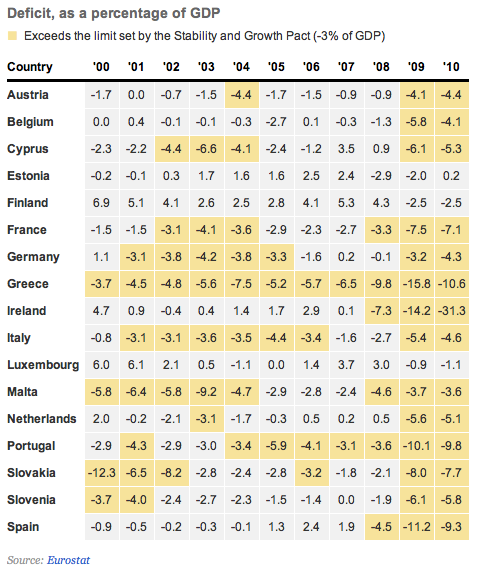
Nur sehr wenige Länder erfüllen im Moment die im neuen EU-Fiskalpakt festgelegten Schuldenobergrenzen. Und es wird für die betroffenen Ländern nur unter großen volkswirtschaftlichen Schmerzen möglich sein, den Vorgaben hinsichtlich der Defizitreduktion gerecht zu werden.

Inwieweit wären EFSF und ESM von Herabstufungen der Kreditwürdigkeit der TripleA-Länder in der Eurozone betroffen?

In the event of a downgrade, S&P’s rating on EFSF will be downgraded to the lowest rating of the previously triple-As countries backing the structure (except Luxembourg6). Since France could potentially be downgraded by two notches, EFSF could potentially be downgraded to AA. If France is ultimately only downgraded by one notch, then EFSF will also only be downgraded one notch since the downgrade of the five triple-As backing the structure will be limited to one notch according to S&P. [...]

Currently, the ESM would have 58.1% share of AAA shareholders. If the six AAA euro area countries are downgraded, then this will drop to zero and it seems highly unlikely that the ESM would be able to achieve an AAA. If France is downgraded to AA flat then we see a significant risk that the ESM will not be able to be rated above that level, particularly if the lending volume significantly exceeds the paid-in capital.


Quelle: FTAlphaville

Sonntag, 11. Dezember 2011

"Kein ökonomisches Desaster im Jahr 2012"

Barry Eichengreen glaubt nicht, dass die Voraussagen der Pessimisten, die davon ausgehen, dass 2012 ein katastrophales Jahr für die Eurozone sein wird, eintreten werden:

Nowadays there is no shortage of pundits, economic or otherwise, warning of impending disaster. ... My view is different: 2012 ... will be a year of muddling through.
Many people think that 2012 will be the make-or-break year for Europe – either a quantum leap in European integration,... or the eurozone’s disintegration, igniting the mother of all financial crises.
In fact, neither scenario is plausible. The collapse of the eurozone would, of course, be an economic and financial calamity. But that is precisely why the European Central Bank will overcome its reluctance and intervene in the Italian and Spanish bond markets, and why the Italian and Spanish governments will, in the end, use that breathing space to complete the reforms that the ECB requires as a quid pro quo. ...
While the eurozone is unlikely to collapse in 2012, there will be no definitive answer to the question of whether the euro will survive, because there will be no quantum leap in European integration. Treaty revisions take time to draft – and more time to ratify. ...
It is a sad state of affairs when a recession qualifies as muddling through. But such is the European condition. ... But muddling through cannot continue forever. Europe needs to draw a line under its crisis and figure out how to grow. The US needs to overcome its political polarization and policy gridlock. And China needs to rebalance its economy – shifting from construction and exports to household consumption as the main engine of growth – while it still has time.
Of course, if none of this happens – or if not enough of it does – 2013 could turn out to be the annus horribilis of the perma-bears’ dreams.


Quelle: Project Syndicate

Samstag, 10. Dezember 2011

Fiskalunion? Eher nicht

Kevin O'Rourke hält es für Irreführung, dass Frau Merkel und andere führende europäische Politiker in Bezug auf die Einigung am EU-Gipfel von einer "Fiskalunion" sprechen:

[T]he most obvious point about the recent summit is that the “fiscal stability union” that it proposed is nothing of the sort. Rather than creating an inter-regional insurance mechanism involving counter-cyclical transfers, the version on offer would constitutionalize pro-cyclical adjustment in recession-hit countries, with no countervailing measures to boost demand elsewhere in the eurozone. Describing this as a “fiscal union,” as some have done, constitutes a near-Orwellian abuse of language.
Quelle: Project Syndicate